OpenZhenZhen AI 프롬프트 갤러리 · gpt-image-2.5 · image
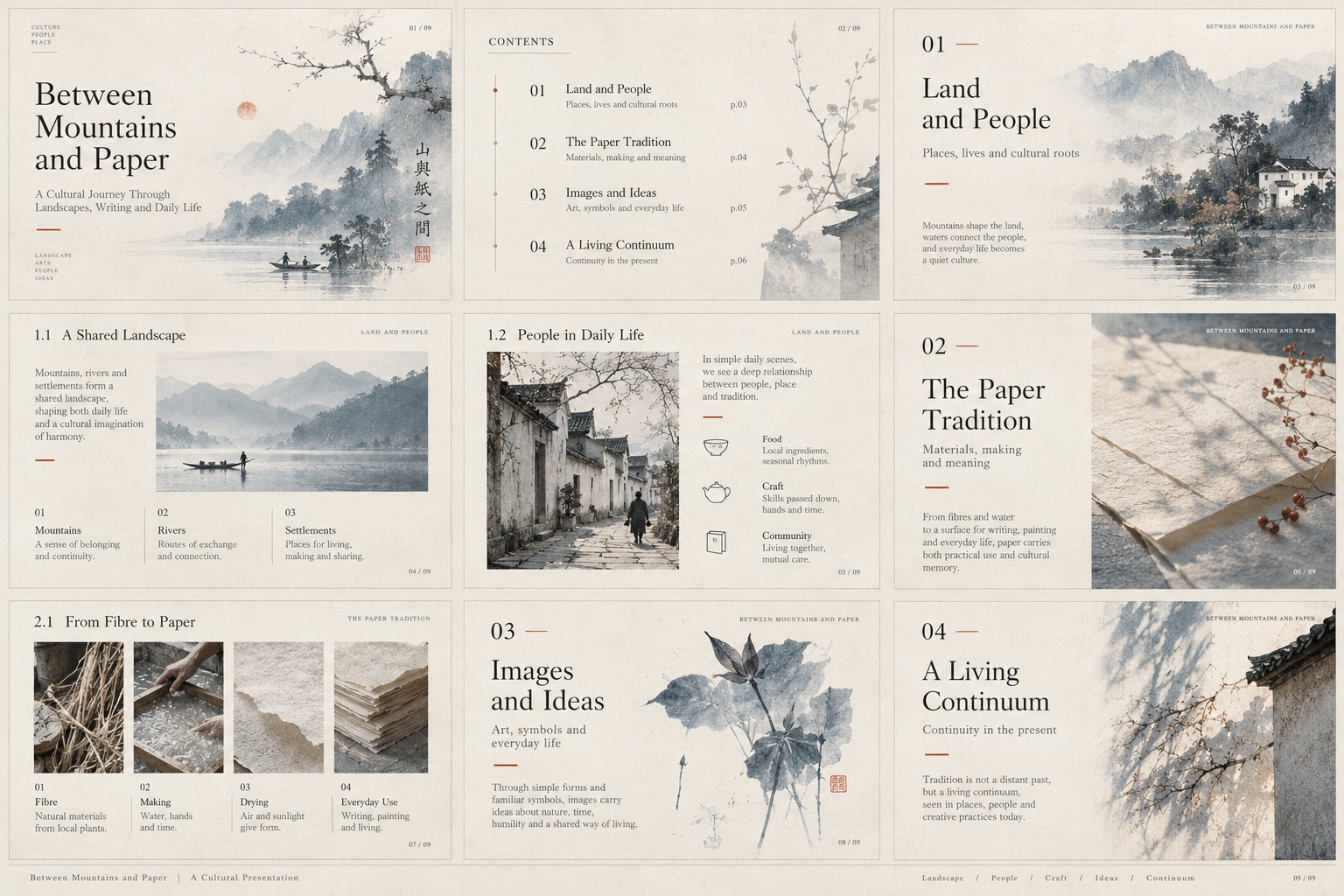
네거티브 스페이스 내러티브 종이 질감 PPT 비주얼 시스템
Negative Space Narrative: Paper-Textured PPT Visual System
‘네거티브 스페이스 내러티브 종이 질감 PPT 비주얼 시스템’은(는) gpt-image-2.5로 만든 작품입니다. OpenZhenZhen에서 원본 프롬프트와 생성 예시를 살펴보고 새로운 창작에 활용해 보세요.
프롬프트
중국어 프롬프트
为纸本影像与静默叙事设计一套克制的PPT视觉系统,呈现一份简洁的文化主题演示,包含标题、章节小标题、注释与页脚信息。以负空间叙事与纸面影像感为核心,采用格式塔连续性、动态平衡、模块网格和基线节奏:用连续性组织细线、投影与文字的缓慢阅读;用不等量配重让大片空场与一侧较高密度结构互相牵制;以模块网格约束信息栏、标题、注释和页脚的对齐。 以理性网格控制边距、栏宽和小字号秩序;以编辑留白与图文呼吸制造停顿;将文化符号几何化为平面结构;以邻接感知维持低彩度层级。配色按角色映射为暖象牙白背景、深灰结构线与正文、半透明低饱和蓝灰影像、克制的铁锈红点缀。保留约7:2:1的面积关系:低彩度高明度背景占最大面积,结构线与正文构成低明度信息层,半透明影像作为中明度氛围层,强调信息仅少量出现并以明度差凸显而不破坏整体克制。未来主题色按这些角色一键映射,同时保持明度顺序、低彩度、透明叠压和投影可读性。 版式采用偏轴模块网格,以空场为主导。由内容叙事决定标题靠近留白内侧、信息列表沿安静轴线排列、焦点影像贴边或越界;唯一有意破格是细线或影像穿越栏线形成视线牵引。背景采用纤维底材、淡化墨洗与摄影转印层叠:先铺吸收性纸纹,再叠加模糊有机方向影、线性框架和细枝状引导线。边缘柔化,局部残旧,光线漫射。 字体采用高反差显示字与低反差小字的对照配对。标题保留修长骨架、开放字腔、细锐收笔与宽松字距;正文和注释用精密紧凑的字号与间距。任何文字系统都须按其合法笔画、字腔、连结、附加标记和阅读方向正确重建,同时保持相近的信息密度与呼吸感。标题、注释和页脚沿网格对齐并清晰可读。 整体情绪含蓄、疏朗、静默、书卷、温润、有秩序且余韵悠长。维持统一的纸本影像系统,避免装饰堆砌、高饱和度、僵硬居中对称、密集网格、任意点缀、不可读字体、亮面渐变和厚重3D效果。
영어 프롬프트
Design a restrained PPT visual system for Paper-based imagery and quiet visual narratives, presenting a concise cultural presentation with a title, section headings, annotations, and footer notes. Apply a negative-space narrative and paper-based imagery, guided by Gestalt continuity, dynamic balance, modular grids and baseline rhythm. Use continuity to organize slow reading of thin lines, shadows and text; use unequal visual weights so generous empty space and a denser structure on one side constrain one another; use a modular grid to align information columns, titles, notes and footers. Use rational grid discipline for margins, column widths and small-type order; editorial white space and image-text breathing to create pauses; geometrized cultural symbols converted into planar forms; and adjacency-based perception to maintain low-saturation hierarchy. Treat the palette by role, using warm ivory background, deep gray structure and body text, translucent muted blue-gray imagery, and a restrained rust accent. Maintain the source's approximate 7:2:1 area relationship: the low-saturation, high-brightness background is the largest carrier layer; structural lines and body copy form the low-brightness information layer; translucent imagery is the medium-brightness atmospheric layer; emphasized information is sparse and gains contrast without breaking the muted hierarchy. Map any future theme palette by these roles, preserving brightness order, low saturation, transparent overlays and shadow readability. Build an off-axis modular composition in which negative space dominates. Let the narrative place titles near the inner edge of open space, information lists along quiet axes, and focal imagery at or across an edge. The only deliberate grid break is a fine line or image crossing a column rule to guide the eye. Construct the background from fibrous paper, faded ink washes and photographic-transfer layers: begin with absorbent texture, then add blurred organic directional shadows, linear frames and delicate twig-like guide lines. Keep edges softly diffused, wear selective and lighting dispersed. Pair high-contrast display typography with low-contrast small text. Give titles slender structure, open counters, fine tapered terminals and generous tracking; use compact small-type annotations with precise spacing. Adapt each writing system according to its valid strokes, counters, connections, diacritics and reading direction while maintaining comparable density and breathing room. Keep titles, notes and footers aligned to the grid and readable. The mood is understated, spacious, quiet, scholarly, warm, orderly and resonant. Preserve a coherent paper-image system rather than decorative clutter; avoid high saturation, rigid centered symmetry, dense grids, arbitrary ornament, illegible type, glossy gradients and heavy 3D effects.
더 많은 이미지·동영상 프롬프트 보기 · 이미지 생성 · 동영상 생성 · AI 캔버스에서 만들기
관련 작품
- 달을 고치는 사람
‘달을 고치는 사람’은(는) Moss Image로 만든 작품입니다. OpenZhenZhen에서 원본 프롬프트와 생성 예시를 살펴보고 새로운 창작에 활용해 보세요.
- 달을 고치는 사람
‘달을 고치는 사람’은(는) Moss Image로 만든 작품입니다. OpenZhenZhen에서 원본 프롬프트와 생성 예시를 살펴보고 새로운 창작에 활용해 보세요.
- 바람에 흩날리는 패션 화보
‘바람에 흩날리는 패션 화보’은(는) Moss Image로 만든 작품입니다. OpenZhenZhen에서 원본 프롬프트와 생성 예시를 살펴보고 새로운 창작에 활용해 보세요.
- 추상적인 빛의 불꽃
‘추상적인 빛의 불꽃’은(는) Moss Image로 만든 작품입니다. OpenZhenZhen에서 원본 프롬프트와 생성 예시를 살펴보고 새로운 창작에 활용해 보세요.
- 세계수
‘세계수’은(는) Moss Image로 만든 작품입니다. OpenZhenZhen에서 원본 프롬프트와 생성 예시를 살펴보고 새로운 창작에 활용해 보세요.
- 자정의 슈퍼카 드리프트
‘자정의 슈퍼카 드리프트’은(는) Moss Image로 만든 작품입니다. OpenZhenZhen에서 원본 프롬프트와 생성 예시를 살펴보고 새로운 창작에 활용해 보세요.