OpenZhenZhen AI 提示词画廊 · gpt-image-2.5 · image
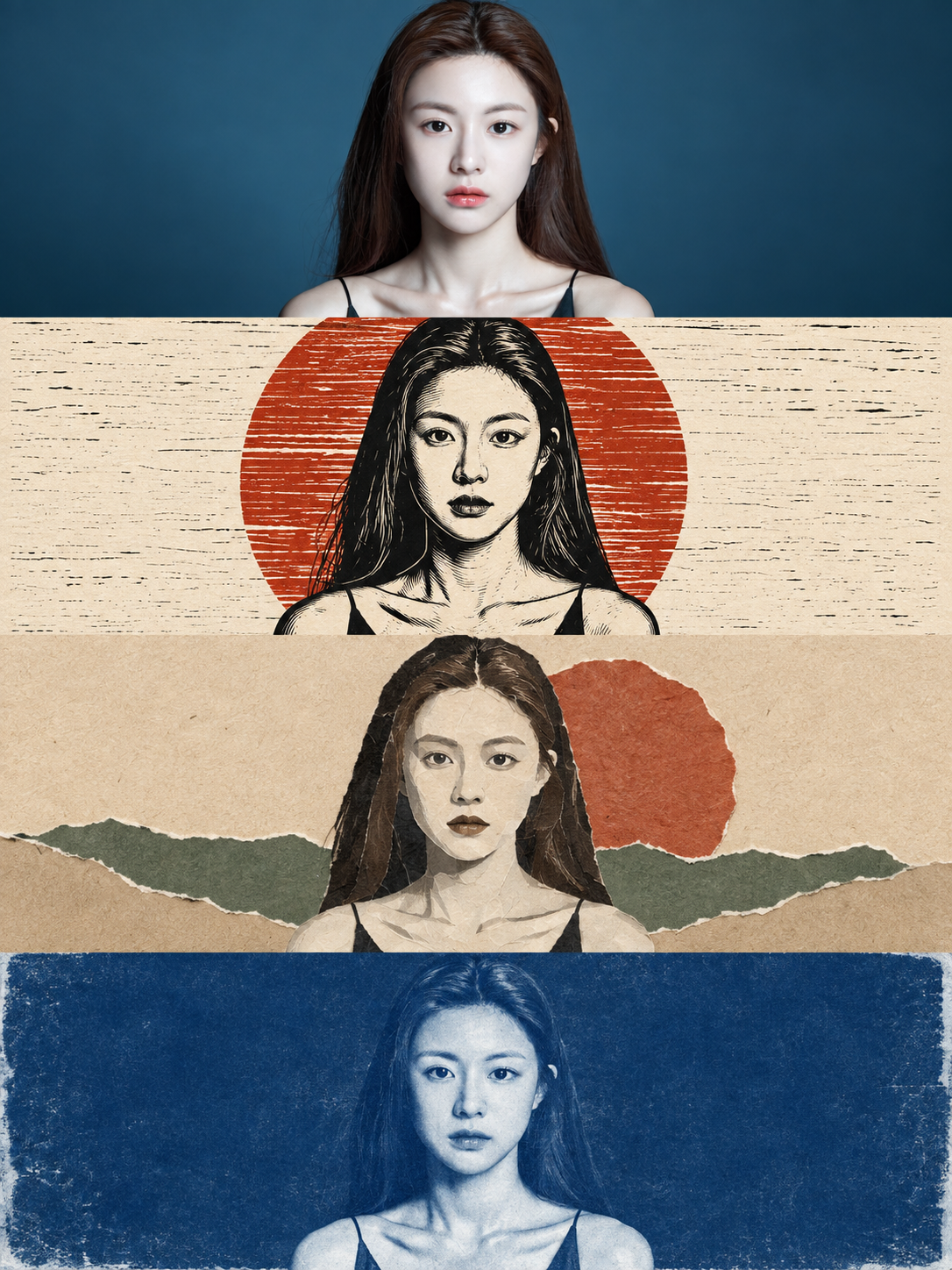
极简艺术风格四层竖版拼图海报
Minimalist Four-Layer Vertical Collage Poster
来自 OpenNana 的图像提示词,已按本地图像分类和站点 gpt-image-2.5 归类整理。 使用时需上传人物参考图;本流程使用统一参考人物生成示例。
提示词 / Prompt
中文提示词
以用户上传的参考图作为主要可见人物的面部身份依据。在不与身份参考冲突的情况下,保留来源的场景、造型、服装、姿势、构图、光线和视觉风格。 请将我上传的照片制作成一张竖版拼图海报,整体采用 3:4 竖版构图。画面从上到下严格四等分为四个横向区域,每个区域的高度必须精确控制为整体画面高度的25%(四层比例严格为1:1:1:1,不允许出现比例偏差),区域之间无缝衔接,不设分隔线、不留间隙,顺序为:原图→风格1→风格2→风格3。由于每层为约3:1的极扁宽幅比例,各层主体建议横向居中排布,强调左右开阔留白与呼吸感,避免元素纵向拉伸变形或贴边拥挤。四层在人物站位、场景结构、视线方向上保持连贯呼应,呈现同一画面、四种转译的整体感。风格层(第二至四层)须遵循极简原则:每层视觉元素数量压缩至最低限度,只保留1个最核心的主体符号,其余次要装饰、背景细节与陪衬元素一律省略,画面留白占比不低于60%。 第一层保留原始照片的主体结构、人物真实互动关系与姿态、真实质感、自然光影与原有色彩氛围,仅进行轻微高级摄影调色,呈现杂志摄影质感,不改变人物关系与构图逻辑,并可在不改变人物关系与构图逻辑的前提下自然扩展天空、地面或环境背景,使整体更具空间感与叙事感。 第二层为木刻版画风格:以高对比黑白木刻刀痕表现场景肌理与人物剪影,辅以一至两处限定色点缀。背景为米白或浅灰纸底,刀痕线条粗犷有力但不杂乱。色彩以黑、米白为主,搭配一处点缀色。避免刀痕过密,避免灰阶层次过多导致画面发灰。 第三层为撕纸拼贴风格:以撕边纸张色块拼贴表现人物与环境,层叠边缘保留自然撕痕肌理。背景为米白牛皮纸底色。主体元素由数张撕边色纸叠放构成,层次不超过三层。色彩控制在2至4种自然色系以内。避免纸片过多导致画面凌乱,避免裁剪边缘过于精细。 第四层为蓝晒氰版风格:采用氰版摄影(蓝晒)风格,以单一普鲁士蓝与白表现人物与环境剪影,营造老工艺质感。背景为米白或浅蓝白底,可有轻微显影颗粒感。色彩为普鲁士蓝与白的单色系。避免加入其他杂色,避免颗粒感过重显脏。 每一层需将主体与场景统一转换为对应风格,整体表达极度克制与简化,只保留最核心的一个主体符号及其基本轮廓关系,删除一切非必要的背景元素、装饰细节与陪衬物;人物之间的关键位置关系、互动方向与姿态特征需保留,但应抽象为可识别的轮廓关系,做到“元素越少、关系越清晰”。色彩均从原图中提取归纳,每层严格控制在2-4种主色以内。四个区域的高度比例须严格保持1:1:1:1(各占25%),不可出现拼接错位或比例偏差。整体避免朋克/赛博朋克风格、写实照片质感强行叠加、卡通风格、3D渲染感、商业海报感、复杂背景堆砌、元素过多或画面拥挤、相邻两层风格雷同,以及任何文字、Logo、水印或标题。
English prompt
Use the uploaded reference image as the facial identity reference for the main visible person. Keep the source scene, styling, clothing, pose, composition, lighting and visual style unless they conflict with the identity reference. Please turn my uploaded photo into a vertical collage poster with an overall 3:4 vertical composition. The image is strictly divided into four horizontal areas from top to bottom, and the height of each area must be precisely controlled at 25% of the overall image height (the ratio of the four layers is strictly 1:1:1:1, no ratio deviation allowed). The areas are connected seamlessly without dividing lines or gaps. The order is: original image → Style 1 → Style 2 → Style 3. Since each layer has an extremely wide ratio of approximately 3:1, it is suggested that the main subject of each layer be arranged horizontally centered, emphasizing open white space and a sense of breathing on the left and right, avoiding vertical stretching deformation or crowded edges. The four layers maintain continuity and resonance in character positioning, scene structure, and line of sight, presenting an overall sense of the same scene through four translations. The style layers (layers 2 to 4) must follow the principle of minimalism: the number of visual elements in each layer is compressed to the minimum, retaining only 1 most core main symbol, and all other secondary decorations, background details, and foil elements are omitted. The white space ratio is no less than 60%. The first layer retains the main structure, real character interaction relationships and poses, real texture, natural light and shadow, and the original color atmosphere of the original photo. Only slight high-end photographic color grading is performed to present a magazine photography texture, without changing the character relationships and composition logic. The sky, ground, or environmental background can be naturally expanded without changing character relationships and composition logic to make the whole more spatial and narrative. The second layer is in woodcut style: high-contrast black and white woodcut knife marks express scene textures and character silhouettes, supplemented by one or two limited color accents. The background is cream or light gray paper, and the knife mark lines are bold and powerful but not messy. Colors are mainly black and cream, paired with one accent color. Avoid overly dense knife marks and avoid too many grayscale levels that make the image look gray. The third layer is in torn paper collage style: torn edge paper color blocks are used to represent characters and the environment, and the layered edges retain natural tear textures. The background is a cream kraft paper base color. The main elements are composed of several torn edge colored papers stacked together, with no more than three layers. Colors are controlled within 2 to 4 natural color systems. Avoid clutter caused by too many paper pieces and avoid overly fine cut edges. The fourth layer is in cyanotype style: using cyanotype photography (blueprinting) style, with single Prussian blue and white representing character and environment silhouettes, creating an old craft texture. The background is cream or light bluish-white, and there may be a slight graininess from development. The color is a monochromatic system of Prussian blue and white. Avoid adding other miscellaneous colors and avoid overly heavy graininess that looks dirty. Each layer needs to uniformly convert the subject and scene into the corresponding style. The overall expression is extremely restrained and simplified, retaining only the most core main symbol and its basic outline relationship, deleting all non-essential background elements, decorative details, and foil items; the key positional relationships, interaction directions, and pose characteristics between characters must be retained but should be abstracted into recognizable outline relationships, achieving "fewer elements, clearer relationships." Colors are all extracted and summarized from the original image, with each layer strictly controlled within 2-4 main colors. The height ratio of the four areas must be strictly maintained at 1:1:1:1 (25% each), and no splicing misalignment or ratio deviation should occur. Overall, avoid punk/cyberpunk styles, forced overlay of realistic photo textures, cartoon styles, 3D rendering feel, commercial poster feel, complex background stacking, too many elements or crowded images, similar styles in adjacent layers, and any text, logos, watermarks, or titles.
探索更多图片和视频提示词 · 生成图片 · 生成视频 · 在 AI 画布中创作
相关作品
- Futuristic Arachnid Mecha
全景图。一辆全新的大型的未来多足科幻战斗机甲,超多炮管和发射机,超多机枪,超多机械臂,类似蛛形纲,压迫感。搭载与车融为一体,风格统一的科幻风格重型武器 车灯亮。车灯的设计非常独特时尚。非常多的层次和细节处理非常细致精致。 以史诗级广角镜头搭配斜视角拍摄,在微观场景中营造出强烈的规模感与压迫感,辛烷渲染与虚幻引擎加持下,超精细的机械结构设计。次世代高模呈现出的奇幻质感,打造出充满科技想象力的概念艺术画面 。 模型完整构图。丰富的细节刻画。 灰色背景。,玻璃材质外壳
- Tropical Beach House
扁平插画风格,主色调暖棕橙黄与浅蓝,氛围温馨宁静,画面质感平滑简洁,色块分明,线条干净利落,没有多余繁杂的装饰。 画面左上角有极细无衬线字体"MEILING",右上角有极细无衬线字体"Seedia Lab"。主体是三亚风格的椰林木屋错落分布,屋旁摆着彩色躺椅,旁有澄澈浅海湾,左上方悬着暖红圆日,图片下方标有"2026"。
- Twilight Mount Fuji
超现实写实风格,主色调为紫棕渐变,氛围静谧悠远,质感细腻带轻微颗粒,晕染出朦胧的暮色意境,柔和的暮光为景物镀上一层绒绒的边。 画面主体是富士山,山顶积雪泛着粉紫光,山脚有温泉町灯火、雾霭湖泊与模糊的复古汽车。
- Hatching Duckling
皮克斯3D动画风格,近景,16:9比例:一颗带棕褐色斑点的白蛋壳在干草堆上裂开缝隙,嫩黄色的小鸭嘴尖从缝里探出,周围散落细碎蛋壳渣,暖谷仓灯光打在蛋壳上,背景是模糊的谷仓干草
- Bioluminescent Vortex Canyon
神秘感和超现实主义风格,画面主体是一个深邃、漩涡状的峡谷,峡谷壁和地面呈现出细腻的细小菌类颗粒感纹理,仿佛由无数微小的发光生物粒子组成,柔软具有一定的光泽感,强烈的动态感,巨大的漩涡结构向画面深处延伸形成旋流动的视觉效果。光影对比强烈,唯一的明亮光源来自峡谷深处散发出金绿色光芒,将远景照亮,强烈的空间感和深度,透视构图,漩涡状的线条,视线引向画面深处的光源。画面底部偏左的位置有一个微小的人形剪影作为画面的焦点,叙事性。以黑+深邃的绿色调为主(黑、深绿色、墨黑色和充满活力的金绿色)整体风格科幻、奇幻、超现实和史诗般,充满探索未知和宏伟壮丽的气息。
- Spring Sunlight Grassland
春日里的阳光、草地、微风、飞鸟留白,金箔岩彩,插画,治愈,春天的配色,绿色,水墨淡彩,大写意,极具观赏性,半透明层,颗粒感,层次感,艺术插画,明显的磨砂颗粒质感,朦胧感,晕开的笔墨触感,细腻的金箔粉岩彩,岩彩肌理质感,烫金丝线纹理,淡雅柔和,流体艺术,简单构图。