OpenZhenZhen AI 프롬프트 갤러리 · gpt-image-2.5 · image
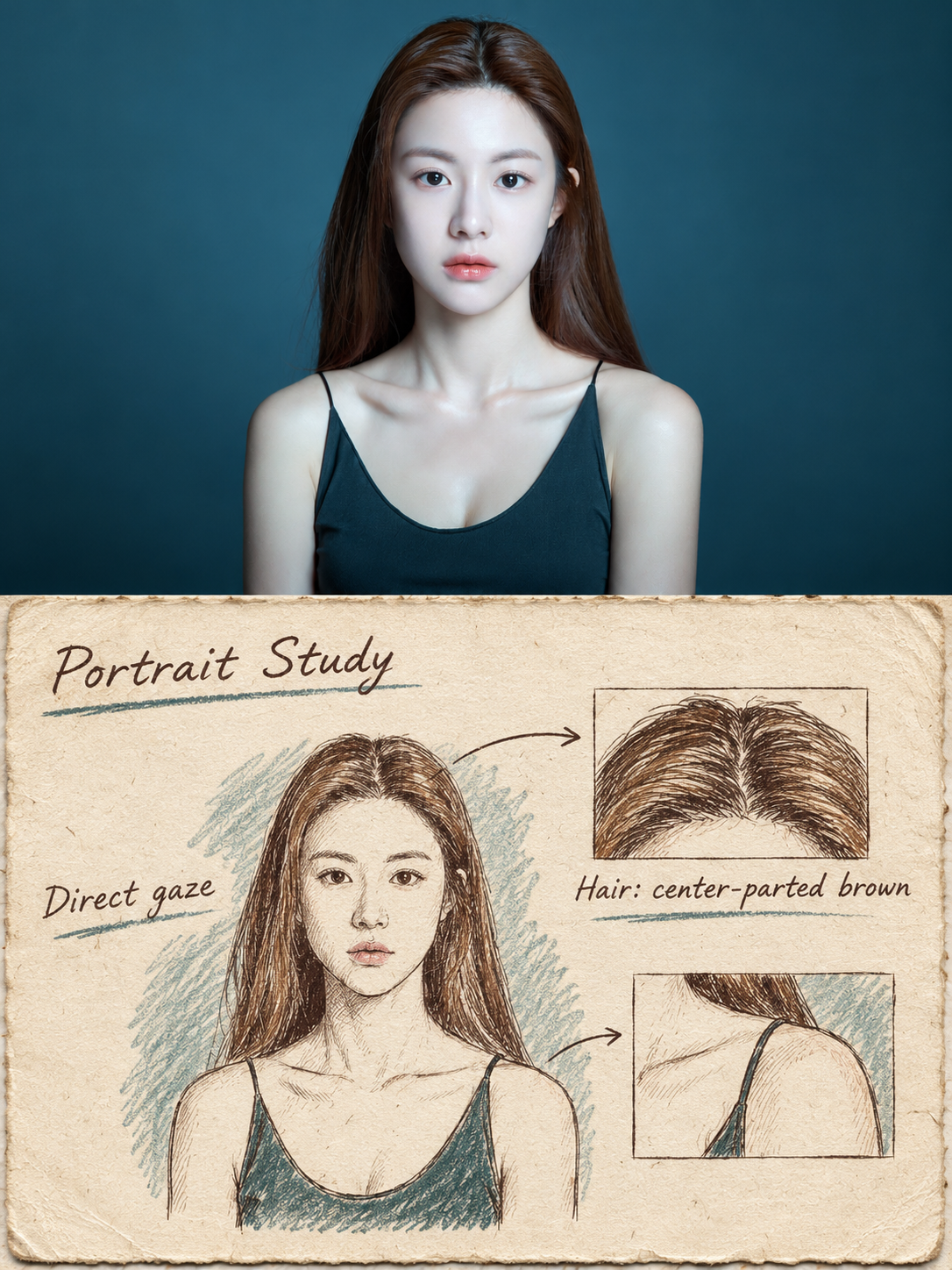
아카이브 카드 현장 수기 기록풍 전후 비교도
Hand-Drawn Archive Card Field Notes: Before and After Comparison
‘아카이브 카드 현장 수기 기록풍 전후 비교도’은(는) gpt-image-2.5로 만든 작품입니다. OpenZhenZhen에서 원본 프롬프트와 생성 예시를 살펴보고 새로운 창작에 활용해 보세요.
프롬프트
중국어 프롬프트
将绑定到 identity_reference(ref-10a-v1)的唯一整幅照片作为唯一事实来源。图中是一位成年女性。制作一张竖版3:4上下对比海报,上下各占全图50%。 上半部分——照片记录区 完整保留原始照片作为清晰的真实摄影记录:保留照片质感、女性身份、数量、姿势、比例、结构、空间关系、自然光线和真实色彩氛围。原照为横幅;保持原比例、不裁切;如需适配版面,只延展现有纯青蓝背景。不得拉伸、扭曲女性或编造事实。上半部分必须仍是真实照片,不画成插图。 下半部分——现场手绘档案卡 将下半区制作成完整的米白色复古档案卡,呈现可见纸纤维与细微旧纸毛边。把同一位女性与同一场景重构为安静的手绘现场记录,只使用最具辨识度的可见细节:居中的面部与直视目光、中分棕色长发、黑色细肩带上衣。主题不限定为船或港口;若替换单张照片,只能使用其中真实主体及两三个可见细节。 使用黑褐色钢笔/签字笔线条、轻微干墨擦痕、手绘抖动、少量重复描线和不均匀墨色,并点缀少量蜡笔或复古丝网印刷色块。整体安静、克制、有观察感和触感,像现场勘察卡或老明信片背面的手绘记录;不要做成光滑矢量图或普通照片滤镜。采用米白底、黑褐线条,并只使用一种从本照片提取的低饱和青蓝色点缀;不要套用固定黄蓝配色。纸纤维、卡片边缘、轻微套印错位、干墨断线和局部色块应参与构图,不要只加颗粒滤镜。 重新组织照片信息,不照搬原取景:缩小主要人像,并将中分发缝与细肩带两个细节局部放大,放入简洁小框并用克制箭头标示。通过尺度、裁切、信息密度和空间组织变化,使档案卡与原照不同构,同时每个细节仍可从真实照片中确认。留出明确的米白呼吸空间,版面应像一张完整实体档案卡,不要做成拥挤贴纸拼贴。 文字 卡片上只使用以下三项简短、清晰的英文文字:标题“Portrait Study”;事实字段“Hair: center-parted brown”;极短观察“Direct gaze”。文字稀疏克制,不加其他文字。不得编造地点、日期、坐标、品牌或网址;不得出现假中文或长段落。 保持严格上下分区,整体为单张竖版画面。禁止左右并排、九宫格、多张照片、“Original/AI”角标和水印。保留同一女性的身份、数量、姿势和观察角度。下半档案卡须为手绘重构,不得只是原图同构临摹。避免纯调色、普通滤镜、3D渲染、卡通模板、无关旅游图标、虚构人物或地标、二维码和过度拥挤。
영어 프롬프트
Use the single attached full photo bound to identity_reference (ref-10a-v1) as the sole source of truth. It shows one adult woman. Create one vertical 3:4 top-and-bottom comparison poster, with each half occupying 50% of the image. UPPER HALF — PHOTO RECORD Retain the complete original photo as a clear photographic record: preserve its real texture, the woman's identity, quantity, pose, proportions, structure, spatial relationships, natural light and true color atmosphere. The photo is wide; keep it uncropped at its natural proportions and, only if needed to fit the panel, extend the existing plain teal-blue background. Do not stretch or distort the woman or invent facts. This is still a real photo area, not a drawing. LOWER HALF — FIELD-DRAWN ARCHIVE CARD Turn the lower half into a complete off-white vintage archive card with visible paper fibers and subtly deckled old-paper edges. Reconstruct the same woman and scene as a quiet hand-drawn field record, using the most recognizable visible subject details: her centered face and direct gaze, long center-parted brown hair, and black thin-strap top. Do not fix the theme to ships or ports; for a substituted single photo, use only its actual subject and two or three visible details. Use dark-brown pen/marker outlines, slight dry-ink scratches, hand-drawn jitter, a few repeated strokes and uneven ink. Add only a small amount of crayon or vintage screen-printed color blocks. Keep the lower card quiet, observational and tactile, like a field-survey card or a hand-drawn note on an old postcard; do not make smooth vector art or apply an ordinary photo filter. Use an off-white base, dark-brown linework and just one restrained low-saturation teal-blue accent extracted from this photo. Do not apply a fixed yellow-blue scheme. Let paper fibers, card edges, slight print misregistration, broken dry-ink lines and local color participate in the composition rather than adding a grain filter. Reorganize the photo information instead of copying its framing: scale down the main portrait, and magnify two small details—the center-parted hair and the thin shoulder straps—in simple local study boxes with restrained arrows. This changes scale, cropping, information density and spatial organization while keeping every detail tied to the real photo. Leave clear off-white breathing space and make the lower area read as one complete physical archive card, not a crowded sticker collage. TEXT Use only these three short, legible English items on the card: title “Portrait Study”; factual field “Hair: center-parted brown”; brief observation “Direct gaze”. Keep them sparse and quiet. Add no other text. Do not fabricate a place, date, coordinates, brand or URL; no fake Chinese or long paragraphs. Keep the top and bottom strictly separated as one vertical composition. No side-by-side panels, nine-grid, multiple photos, “Original/AI” labels or watermark. Preserve the same person's identity, quantity, pose and observation angle. The lower card must be a hand-drawn reconstruction, not an isomorphic copy. Avoid pure color grading, ordinary filters, 3D rendering, cartoon templates, irrelevant travel icons, invented people or landmarks, QR codes or overcrowding.
더 많은 이미지·동영상 프롬프트 보기 · 이미지 생성 · 동영상 생성 · AI 캔버스에서 만들기
관련 작품
- 청록색 인물 고정보 광고 포스터
‘청록색 인물 고정보 광고 포스터’은(는) gpt-image-2.5로 만든 작품입니다. OpenZhenZhen에서 원본 프롬프트와 생성 예시를 살펴보고 새로운 창작에 활용해 보세요.
- 청록색 인물 초상 개인 이미지 전단지
‘청록색 인물 초상 개인 이미지 전단지’은(는) gpt-image-2.5로 만든 작품입니다. OpenZhenZhen에서 원본 프롬프트와 생성 예시를 살펴보고 새로운 창작에 활용해 보세요.
- 틸 앤 오렌지 황무지: 사막 추격의 생존자들
‘틸 앤 오렌지 황무지: 사막 추격의 생존자들’은(는) gpt-image-2.5로 만든 작품입니다. OpenZhenZhen에서 원본 프롬프트와 생성 예시를 살펴보고 새로운 창작에 활용해 보세요.
- 차가운 회색 미니멀 실내의 투명 우비를 입고 도끼를 든 초상
‘차가운 회색 미니멀 실내의 투명 우비를 입고 도끼를 든 초상’은(는) gpt-image-2.5로 만든 작품입니다. OpenZhenZhen에서 원본 프롬프트와 생성 예시를 살펴보고 새로운 창작에 활용해 보세요.
- 연한 베이지 배경의 6분할 스튜디오 증명사진풍 초상
‘연한 베이지 배경의 6분할 스튜디오 증명사진풍 초상’은(는) gpt-image-2.5로 만든 작품입니다. OpenZhenZhen에서 원본 프롬프트와 생성 예시를 살펴보고 새로운 창작에 활용해 보세요.
- 픽사 스타일 금발 주근깨 아바타
‘픽사 스타일 금발 주근깨 아바타’은(는) gpt-image-2.5로 만든 작품입니다. OpenZhenZhen에서 원본 프롬프트와 생성 예시를 살펴보고 새로운 창작에 활용해 보세요.